Buying Stainless Steel Pipe is not simply a matter of choosing a diameter and accepting the lowest quotation. The right decision depends on grade, dimensions, manufacturing quality, surface condition, and the environment where the pipe will operate. A pipe used for clean water may face very different demands from one exposed to salt spray, chemicals, heat, or repeated pressure. Small details matter. A rough weld, unclear wall thickness, or missing test document can create expensive problems later.
This guide presents seven practical tips for evaluating suppliers and products with greater confidence. It considers common grades such as 304 and 316, while explaining why application conditions should guide the final choice. It also examines tolerances, seamless or welded construction, surface finishes, inspection records, packaging, and delivery terms. Experienced buyers often request mill certificates, verify markings, and inspect several pieces instead of trusting one polished sample. That habit is useful, though not perfect. Documents can be accurate while handling damage remains unnoticed. Measurements can pass while the chosen grade is unsuitable for long-term exposure.
Look closely.
Questions should be specific and written clearly. Confirm outer diameter, schedule, length, end preparation, and acceptable tolerances before production begins. Reliable suppliers explain limitations instead of promising everything. Independent inspection may add cost, but it can reveal issues before installation. A careful purchase protects performance, budget, and project credibility. Even a well-planned order deserves one final review, because assumptions are often the weakest part of a specification.
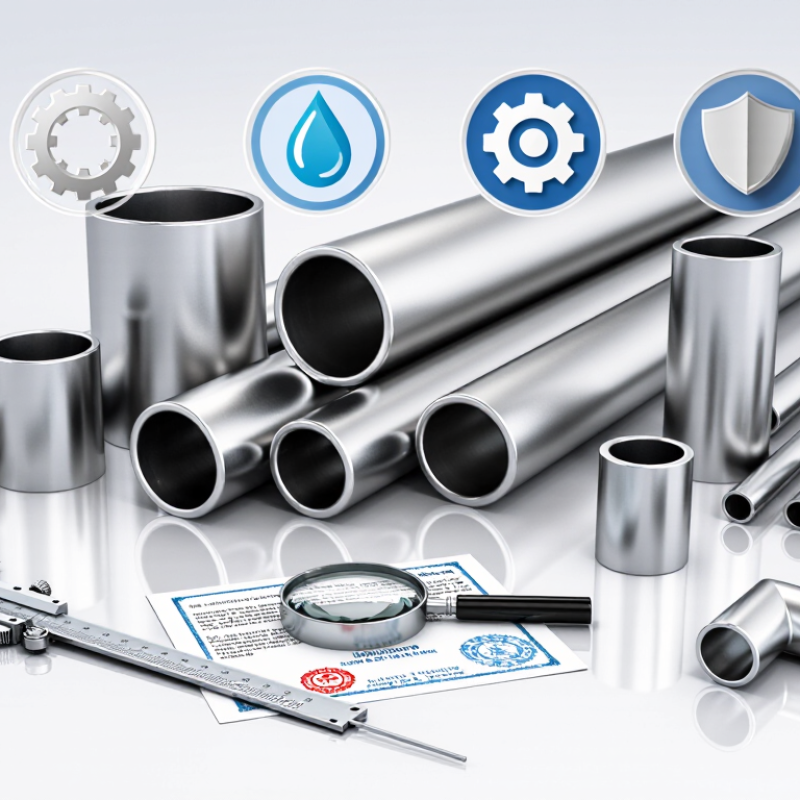
7 Tips for Buying Stainless Steel Pipe
Identify the Right Stainless Steel Grade for Your Application
Tip 1: Define the service environment before comparing prices. Moisture, chlorides, acids, temperature, and pressure can change the correct grade. Grade 304 suits many indoor and general process systems. Grade 316 offers better resistance in chloride-bearing environments. Still, 316 is not immune to corrosion. Tip 2: Check the fluid’s chemistry, not only its name. “Water” may contain salt, disinfectants, or acidic cleaners. Tip 3: Match the grade with temperature and pressure requirements. Duplex 2205 can provide higher strength, but welding and heat treatment demand tighter control.
World Stainless reported approximately 58.4 million tonnes of crude stainless steel production in 2023. That scale supports broad grade availability, but availability does not prove suitability. Tip 4: Confirm the applicable specification, such as ASTM A312 for austenitic pipe or ASTM A790 for duplex pipe. Tip 5: Request the material test certificate, heat number, dimensions, and corrosion-related test results. Tip 6: Use positive material identification when the application is critical. A handheld analyzer can expose a costly mix-up before installation.
Tip 7: Review the whole life cycle. A cheaper grade may require earlier replacement, thicker walls, or more frequent cleaning. Engineers should also inspect weld discoloration, surface scratches, and drainability. No grade is perfect. I have seen selection decisions rely too heavily on a catalog table. That approach needs reflection. Consult a qualified materials engineer when chemicals, high heat, or chloride deposits are present.
| Tip | Selection Factor | Suitable Stainless Steel Grades | Typical Chemical Data | Typical PREN Range | Recommended Applications | Important Limitations and Buying Checks |
|---|---|---|---|---|---|---|
| 1 | Identify the corrosive environment Consider chlorides, acids, alkalis, moisture, salt spray, and stagnant conditions. |
304 / 304L 316 / 316L 2205 Duplex 904L |
304 / 304L: approximately 18% Cr, 8% Ni 316 / 316L: approximately 16–18% Cr, 10–14% Ni, 2–3% Mo 2205: approximately 22% Cr, 4.5–6.5% Ni, 3% Mo, nitrogen addition 904L: approximately 19–23% Cr, 23–28% Ni, 4–5% Mo |
304 / 304L: approximately 18 316 / 316L: approximately 23–27 2205: approximately treinta–38 904L: approximately 34–40 |
304 / 304L: indoor equipment, food-processing areas, general piping 316 / 316L: marine atmospheres, chemical processing, chloride exposure 2205: high-chloride service, pressure piping, structural applications 904L: highly aggressive acidic environments |
PREN is only a comparative indicator and does not replace corrosion testing. Avoid relying on 304 in warm, salty, or chloride-rich service. Confirm the exact medium, concentration, temperature, flow velocity, and risk of crevice corrosion before purchasing. |
| 2 | Check the required temperature range Evaluate both continuous operating temperature and short-term excursions. |
304 / 304L 316 / 316L 321 347 |
304 / 316: general cryogenic and elevated-temperature service when properly specified 321: titanium-stabilized austenitic grade 347: niobium-stabilized austenitic grade |
PREN is not a temperature rating. Temperature capability depends on design code, pressure, wall thickness, oxidation conditions, and fabrication. | 321 and 347 are commonly considered for welded equipment and piping exposed to prolonged elevated temperatures, including exhaust, heat-transfer, and process systems. | Do not select a grade using melting point alone. Request allowable stress values from the applicable design code. At elevated temperature, sensitization, creep, oxidation, thermal cycling, and weld procedure can control service life. |
| 3 | Match the pipe to welding requirements Review carbon content, weld method, joint design, and post-weld treatment. |
304L 316L 321 347 2205 |
Low-carbon “L” grades: carbon typically ≤0.030% under common product specifications 321: stabilized with titanium 347: stabilized with niobium 2205: duplex stainless steel with balanced austenitic-ferritic structure |
Duplex grades generally provide higher resistance to chloride stress-corrosion cracking than standard austenitic grades, but welding requires tighter heat-input and interpass-temperature control. | 304L and 316L are practical choices for many fabricated systems. 321 and 347 are useful for high-temperature welded assemblies. 2205 is suitable where strength and chloride resistance are both important. | Ask for a qualified welding procedure, filler-metal specification, heat input controls, and weld inspection requirements. Improper duplex welding can reduce toughness and corrosion resistance. |
| 4 | Determine the required strength and pressure capability Consider internal pressure, external loads, vibration, thermal expansion, and safety factors. |
304 / 316 304L / 316L 2205 Duplex |
Typical minimum room-temperature tensile strength varies by product standard and condition. Common annealed values are approximately: 304 / 316: 485–515 MPa tensile strength 2205: about 620 MPa tensile strength |
PREN does not indicate mechanical strength. Duplex 2205 generally offers substantially higher yield strength than conventional 300-series austenitic grades. | 304 and 316 are widely used for general pressure and process piping. 2205 can reduce wall thickness or improve design margin where permitted by the applicable code. | Do not size pipe from tensile strength alone. Verify nominal outside diameter, wall thickness, tolerance, design pressure, design temperature, corrosion allowance, ovality, and the governing piping code. |
| 5 | Select the correct product form and dimensions Choose seamless or welded pipe according to pressure, fabrication, and inspection requirements. |
304 / 304L 316 / 316L 321 347 2205 |
Common dimensional references include outside diameter, nominal pipe size, wall thickness, schedule, length, straightness, and end preparation. | Grade selection and dimensional selection are separate decisions. A corrosion-resistant grade can still fail if the wall thickness or fabrication quality is inadequate. | Welded pipe may be economical for many larger-diameter systems. Seamless pipe is often selected for demanding pressure, high-temperature, or critical-service applications, subject to code and project requirements. | Confirm the applicable dimensional standard, pipe schedule, length tolerance, weld condition, heat treatment, hydrostatic or nondestructive testing, and end type before placing an order. |
| 6 | Evaluate fabrication, forming, and surface requirements Consider bending, flaring, machining, polishing, passivation, and cleaning. |
304 / 304L 316 / 316L 321 2205 |
Austenitic grades such as 304 and 316 generally provide good forming and weldability. Duplex 2205 provides higher strength but has different forming behavior and requires controlled fabrication practices. | Surface condition strongly affects corrosion performance. Smooth, clean, properly pickled, and passivated surfaces generally perform better than contaminated or heat-tinted surfaces. | 304 is commonly used for general sanitary and architectural work. 316L is often selected for hygienic or chloride-exposed systems. 2205 is suitable when strength and corrosion resistance outweigh easier forming. | Specify surface finish, roughness target where required, pickling and passivation, internal cleanliness, protection from carbon-steel contamination, and acceptable weld discoloration. |
| 7 | Verify standards, certificates, and total cost Compare lifecycle cost rather than purchase price alone. |
304 / 304L 316 / 316L 321 347 2205 904L |
Require traceability to the specified material standard, heat or batch identification, chemical analysis, mechanical test results, dimensions, heat treatment, and inspection results. | PREN and nominal composition should be verified against the actual material test certificate, not assumed from a grade name alone. | Lower-alloy grades may have a lower purchase price but higher maintenance risk in aggressive environments. Higher-alloy grades may reduce replacement, cleaning, downtime, or corrosion-control costs. | Review material certificates, positive material identification requirements, third-party inspection, test methods, packaging, storage, delivery condition, and warranty terms. Confirm that all values comply with the project specification and applicable standard. |
Match the standard to pressure, temperature, corrosion exposure, and application conditions. A cheaper pipe may fail. Do not compare prices first.
It should list the alloy grade, chemical composition, mechanical properties, heat number, and inspection results. The certificate should match the delivered batch. Paperwork can still contain gaps.
Compare the heat number on the certificate with markings on the pipe. Check several pieces, not only one. Missing markings deserve a pause.
Specify whether the surface is polished, brushed, pickled, or passivated. Request roughness values when hygiene or cleaning is important. Appearance alone is not enough.
Use bright, angled light. Look for dents, scratches, pits, rust stains, discoloration, and uneven polishing. Inspect sample sections closely. Clean-looking bundles can hide damage.
Measure outside diameter, wall thickness, and length with calibrated tools. Check several points along each pipe. Transport can cause deformation.
Check seams for cracks, undercutting, excessive grinding, and uneven finishing. A smooth seam does not prove sound construction. Look more closely.
Compare at least three detailed offers. Check cutting, packing, testing, documentation, payment stages, and measured quantity. A low price may exclude important costs. That mistake is easy to make.
Record production time, inspection dates, loading arrangements, delivery location, delay notices, and replacement procedures. Confirm whether partial shipments are possible. Written details reduce confusion.
Recheck markings, dimensions, packaging, straightness, and pipe ends. Photograph questionable areas before signing. Inspect random pieces after unloading. One inspection is rarely perfect.
Buying the right Stainless Steel Pipe requires more than comparing prices. Start by identifying the stainless steel grade that suits your application, considering factors such as corrosion exposure, temperature, pressure, and required strength. Then confirm the pipe’s outside diameter, wall thickness, schedule, length, and connection type are compatible with your system. It is also important to review applicable quality standards, material certifications, test reports, and surface finish requirements to ensure the pipe meets both performance and appearance expectations.
When comparing suppliers, evaluate their production consistency, communication, lead times, payment conditions, packaging, and after-sales support rather than focusing only on the lowest quotation. Before accepting the shipment, inspect the pipes for correct dimensions, visible damage, rust, dents, surface defects, marking accuracy, and quantity. Checking documentation against the delivered products can help identify problems early and reduce installation delays, replacement costs, and long-term maintenance risks.

 Oes Steel